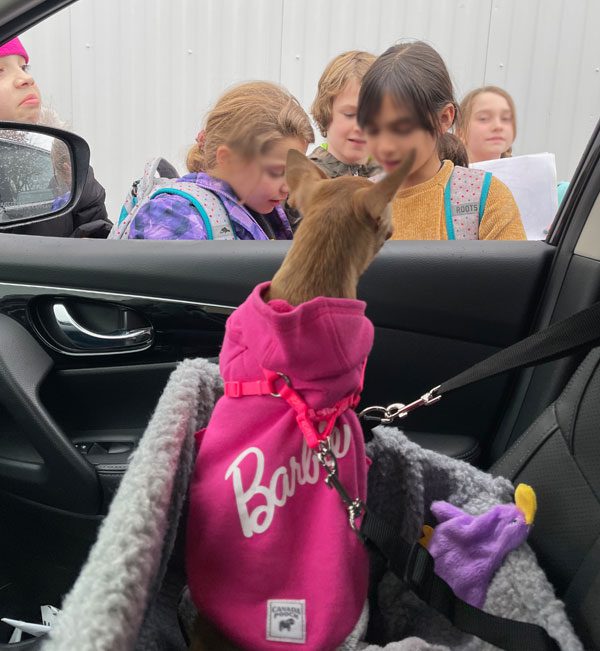


Picture it. You are out for a walk with your chihuahua, everything is calm, and then a Labrador rounds the corner. Your little dog goes from relaxed to rigid in half a second. The barking starts. The lunging starts. The shaking starts. And the person with the Labrador looks at you like your dog is the rude one.
Your dog is not rude. Your dog is scared. And the science says your chihuahua has good reason to feel that way.
The Short Answer: Yes, and It Is Not Just Your Dog
A large study of about 6,000 pet dogs in Finland, published in Scientific Reports in 2020, looked at which dogs were afraid of other dogs. Small dogs were more fearful than medium and large dogs, and of all the breeds in the study, the chihuahua came out as the most fearful of other dogs.
That finding lines up with other research. A study of more than 8,300 dogs across 80 breeds found that as a dog’s height and body weight went down, problem behaviors went up, including aggression. A study of more than 9,000 dogs found the same pattern, with fearfulness the strongest predictor of aggression, and aggressive dogs more than three times as fearful as other dogs.
So when your chihuahua loses it at the sight of a big dog, that is not drama. That is a tiny animal doing the math on a creature ten times its size and deciding the situation is dangerous.
Why Big Dogs Feel So Scary to a Chihuahua
Start with the obvious: the size difference. A chihuahua weighs three to six pounds. A Labrador weighs sixty to eighty. To your chihuahua, even a polite big dog is enormous, fast, and hard to read from down at ankle height.
Then add the things that make it worse:
- A bad experience. One rough greeting, one big dog that bowled them over, one off-leash dog that rushed them, and the lesson sticks. Dogs do not need many repetitions to learn that something is scary.
- Too little early exposure. Puppies that rarely met calm, friendly big dogs during their first few months often grow up treating every large dog as an unknown. Unknown, to a small dog, usually means unsafe.
- Being scooped up all the time. Chihuahuas get picked up more than any other breed, often without warning. A dog that is constantly lifted, moved, and carried can start to feel like it has no control over what happens to its own body. That feeling feeds defensiveness.
- Being on a leash. A leashed dog cannot move away from something scary, and moving away is the one thing a frightened animal most wants to do. That is why many chihuahuas are fine with a big dog across a park and furious with the same dog at six feet.
- Owner reactions. If we tense up, shorten the leash, or start scolding the moment a big dog appears, our dog reads that and concludes the big dog really is a problem.
What Fear Actually Looks Like
Barking and lunging are the loud signs. But fear usually shows up quietly first. Watch for:
- Tail tucked tight, ears pinned back, body low to the ground
- Trembling, freezing in place, or turning the head away
- Hiding behind your legs
- Lip licking or yawning when they are not tired
- Refusing a treat they normally love
- Pulling hard to get away
Barking, growling, and snapping sit at the far end of that list. They are the last warning, used when everything quieter has already failed. A growl is communication, not bad manners. Never punish a dog for growling. If you take the growl away, you take the warning away, and the next step is a bite with no warning at all.
What Not to Do
The instinct is to fix it fast, and most of the fast fixes make it worse. Do not drag your chihuahua toward a big dog so they can say hello. Do not flood them with dog after dog hoping they will get used to it. Flooding a frightened dog does not teach confidence. It teaches that their fear was justified.
And do not laugh it off. It is easy to smile at a five-pound dog barking at a ninety-pound one because it looks funny. But your chihuahua is genuinely afraid, and being laughed at does not make fear smaller.
The Plan That Actually Works
The goal is not to make your chihuahua love every big dog. It is to change how they feel when one appears, from dread to something closer to neutral. That takes small, positive experiences, repeated over time:
- Start at a comfortable distance. Find the distance where your chihuahua notices the big dog but can still look at you, sniff the ground, and take a treat. If they are barking, lunging, or refusing food, you are too close. Move farther away.
- Make big dogs predict wonderful things. Every time a big dog appears at that comfortable distance, something your chihuahua loves appears too: a piece of chicken, a bit of cheese, their favorite treat. Dog appears, wonderful thing happens. Over time the feeling shifts from oh no to hey, where is my chicken? Trainers call this counter conditioning, because it changes the emotion underneath the barking, not just the barking.
- Let them look, then reward. Let your chihuahua look at the big dog. The moment they look, say yes and give the treat. Then let them look again. You are teaching them that looking at a big dog is a safe thing that pays off.
- Shrink the distance slowly. Only move a few steps closer once your chihuahua is relaxed at the current distance, loose body, taking treats easily, no barking. If they react, you went too fast. Go back to where they were comfortable and try again another day.
- Use parallel walks. Walking in the same direction as a calm big dog, on the far side of the path, is one of the easiest introductions there is. No face-to-face greeting, no pressure, just walking together.
- Pick calm helper dogs. Not every big dog is a good teacher. The right one is calm, well socialized, and not bouncy, because one chaotic greeting can undo weeks of careful work.
- Advocate for your dog. When someone says their dog is friendly and lets it rush over, it is fine to say, not today, we are training. Your chihuahua cannot say it. You can.
One note on picking them up: if a large off-leash dog is rushing toward you, pick your chihuahua up. Safety first. But do not make carrying the everyday solution, because a dog that is always carried never learns that big dogs at a distance are safe.
When to Get Extra Help
If your chihuahua’s fear appeared suddenly, when they used to be fine around other dogs, start with a vet visit. Pain, illness, or failing eyesight or hearing can turn a confident dog fearful, and behavior work will not fix a medical problem.
If the fear is severe, getting worse, or your chihuahua has bitten, bring in a certified professional dog trainer or a veterinary behaviorist. Look for someone who works with fear using positive methods, not punishment. A good professional will set up controlled introductions with calm helper dogs, which is very hard to arrange on your own.
The Bottom Line
Your chihuahua is not being dramatic, stubborn, or badly behaved. They are a three-pound animal in a world full of creatures ten times their size, and the research says their breed feels that size gap more keenly than any other. The barking is fear talking.
The good news is that fear can change. Distance, good treats, patience, and a calm big dog or two can teach a chihuahua that large dogs are not all emergencies. It will not happen in a week, but every calm walk where nothing bad happens is a deposit in the trust account.
Lupini has her own opinions about big dogs, and she is not shy about sharing them. But she is learning, one careful introduction at a time, that not every large dog is a threat. Your chihuahua can learn that too.
General information only — not veterinary or behavioral advice. If your chihuahua is fearful, aggressive, or has bitten, talk to your veterinarian or a certified professional dog trainer.